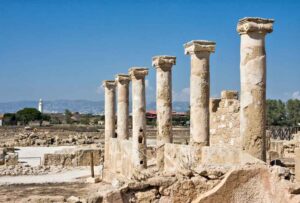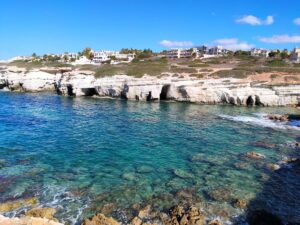
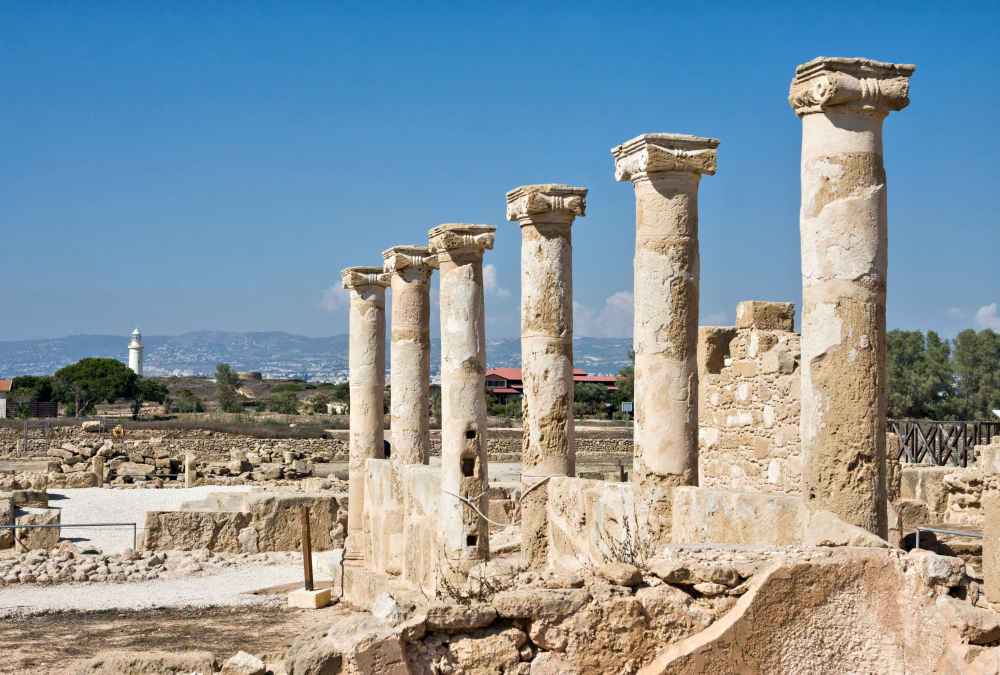
By the harbour of modern Paphos, Kato Pafos Archaeological Park opens a quiet window into the ancient world. Stone paths lead through ruins shaped by Greek, Roman, and early Christian life, where history feels close enough to touch and the sea is never far from view.
Why should you visit Kato Pafos Archaeological Park
This is one of the most important archaeological sites in Cyprus and has been listed as a UNESCO World Heritage Site since 1980. It covers a wide area of ancient Nea Paphos, once the capital of Cyprus, and brings together centuries of history in one open space.
Walking through the park feels like moving through layers of time. You will pass Roman villas, early Christian ruins, public buildings, and traces of medieval life, all set within a landscape that still feels open and coastal.
The most famous treasures are the mosaic floors of four Roman villas, known as the Houses of Dionysos, Theseus, Aion, and Orpheus. These mosaics show scenes from Greek mythology, hunting life, and daily Roman culture, using colour and detail that remain striking even today.
The House of Dionysos is the largest and most impressive, with hundreds of square metres of mosaic floors showing mythological stories and hunting scenes. Beneath it lies an older pebble mosaic of the sea monster Scylla, linking different eras in one place.
The House of Theseus once belonged to the Roman governor and includes the famous scene of Theseus fighting the Minotaur. The House of Aion, though smaller, contains one of the finest Roman mosaics in Cyprus, showing the god Aion surrounded by symbolic scenes. The House of Orpheus, though not always open, adds further mythological depth to the site.
Beyond the villas, you will find the ancient Odeon, the Agora, the Asklepieion healing centre, the Saranta Kolones fortress, early Christian basilica ruins, and parts of the ancient lighthouse area. Each section adds another chapter to the story of Paphos as a powerful ancient city.
The park is still under excavation, and new discoveries continue to appear. This gives the place a living quality, where history is not only preserved but still being uncovered.
Tangerine Suggests
Visit early in the morning or later in the afternoon, wear comfortable shoes, and bring water and sun protection, as there are no shops inside the park.
Getting there
The park is located near Paphos harbour and can be reached easily on foot from the old town or by car, taxi, or local bus.
Perfect for
- History and culture lovers
- Slow walking and exploring
- Photography and architecture fans
- Visitors curious about ancient Cyprus